
Client work
Scope Creep: How to Say No to “Just One More Thing”
By Aetisam · · 6 min read
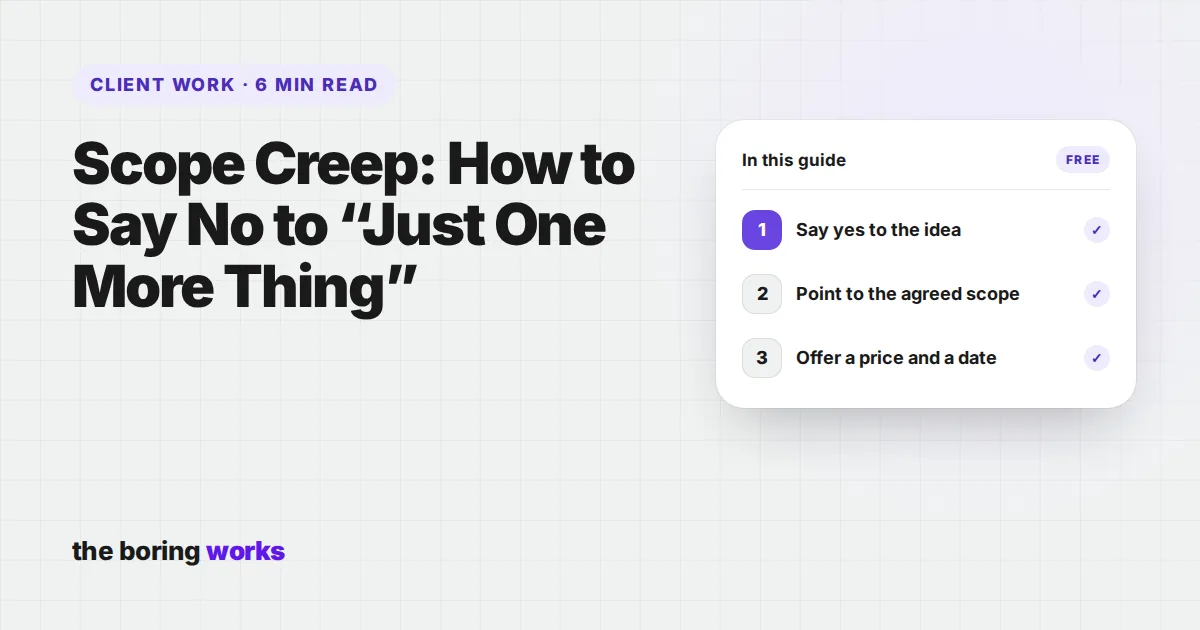
The short answerScope creep is when a project grows past what you agreed, one small request at a time. To handle it, say yes to the idea, point back to the written scope, and quote the extra work as a change request. To prevent it, write down deliverables, revision rounds, and approvers before you start.
It never starts big. "Could you also add a testimonials page?" Sure, that is quick. "What if we tried a different color?" Fine. "Can we get a version for Instagram too?" Why not. By week four, you are building a second project for the price of the first one, and the client has no idea anything changed, because every request sounded tiny.
That is scope creep, and nearly every freelancer meets it. The good news is that it is almost never about a bad client. It is about a vague agreement, and a vague agreement is something you can fix.
What is scope creep?
Scope creep is when the work grows beyond what you agreed, without the price or the deadline growing with it. The "scope" is the list of what is included. The "creep" is the slow, polite way extra things get added. Most clients are not trying to take advantage. They simply do not know what counts as extra, because nobody told them.
Why does scope creep happen to freelancers?
- The scope was one vague line, like "design a website", with no list of what that includes.
- Nobody said how many rounds of revisions are included.
- More people on the client’s side joined late and all want a say.
- You said yes to a small thing to be nice, and that set the pattern.
- The client has no idea what each extra costs in your time.
How do you stop scope creep before it starts?
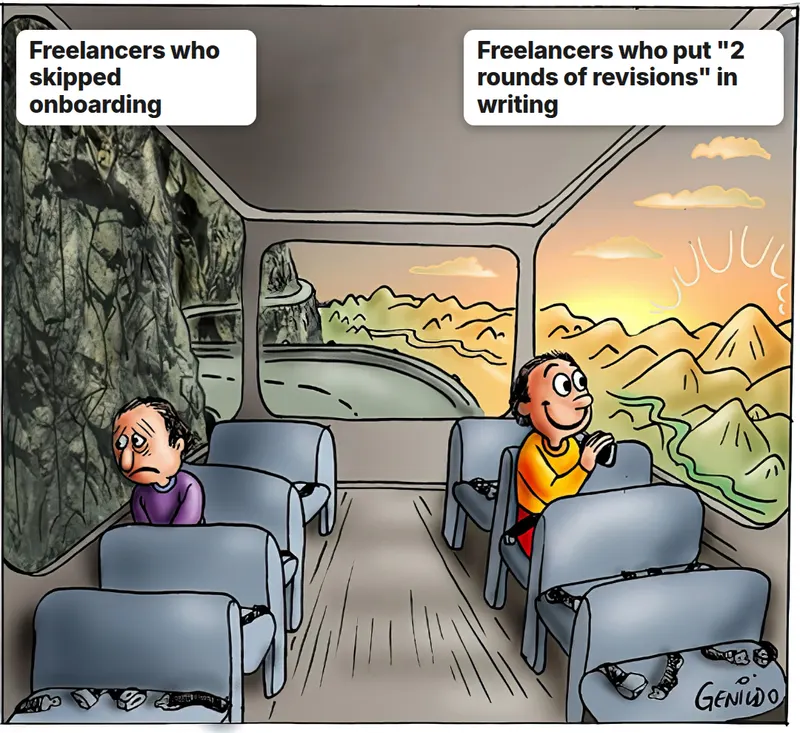
Prevention is boring and it works. Freelancer guides agree on the basics. Payoneer says to itemize deliverables instead of writing one vague line, Fiverr Workspace suggests capping revisions, and Creative Bloq suggests getting a written brief signed off by everyone on the client’s side who will have an opinion.
- The exact deliverables (pages, files, formats), not just "a website"
- How many revision rounds are included, and what counts as one
- Who gives feedback, and who has the final say
- What is not included, written down on purpose
- How changes are priced, and that they need approval first
- Deadlines for client feedback, and what happens if they run late
This is exactly what a good client onboarding process does. Scope is not a conversation to have once things get awkward. It is a document to agree on before the work starts, when everyone is still happy.
What should you say when a client asks for more?
Use a short, calm reply that keeps the relationship warm and the work fair. One widely shared approach, described by Upwork Launch Codes, has three parts.
- 1Say yes to the ideaRespond warmly. "Great idea" costs nothing and keeps the mood good.
- 2Point to the agreed scopeRemind them, kindly, what the project currently includes. Many clients honestly do not realise they are asking for extra.
- 3Offer a price and a dateGive them a quote and a timeline for the addition, so the choice is theirs: pay for it, or keep to the plan.
The standard reply
Love that idea. It’s outside what we agreed for this project, which covers [list]. I can add it for [price] and it would add [number] days. Want me to send a short change request?
When it is a big ask
That’s a great next step, and it’s a bigger piece of work than the current scope. I’d suggest making it phase two so we hit the deadline on what we’ve agreed. Happy to put a quote together.
A small ask you will do once
Happy to do this one as a one-off. For future requests like this, I’ll send a quick quote first so we both know where we stand.
A change request (short form)
Change request: [what]. Not in the original scope. Cost: [price]. Extra time: [days]. Approve by replying "approved", and I’ll start straight away.
When is it fine to say yes to extra work?
Sometimes a small favor for a good client is smart business. Use judgment: is it quick, is it a valuable relationship, and will it set a habit you cannot afford? If you decide to say yes, make it visible. A tip from Fiverr Workspace is to list the extra work on the invoice with a 100% discount. It shows the client that it normally costs money, and it reminds them you were generous.
| Quote it | Fine to do once |
|---|---|
| It takes more than an hour or two | It is quick, under half an hour |
| It adds a new deliverable or page | It is a tweak, not a new item |
| It is the third "small thing" this week | It is a first, not a pattern |
| It delays the agreed deadline | You show it on the invoice at 100% off |
What if the client pushes back?
Stay friendly, stay specific, and offer options. Moxie suggests a menu of paid add-ons. It is a calm way to do it, because the client decides what they want to pay for. You are not refusing. You are giving them a choice. If they still push, repeat the scope and the offer in the same warm tone. You do not need to win an argument. You just need to keep the agreement clear.
If a client keeps ignoring boundaries, it may be a sign of a bigger pattern. Our guide on freelancer burnout explains how saying yes to everything wears people down, and why setting limits protects your work and your health.
A scope check for every project
- Step 1Before signingDeliverables, revisions, approvers, and exclusions written down
- Step 2KickoffWalk the client through the scope so nobody is surprised later
- Step 3MidwayConfirm what is done, what is next, and flag anything outside scope
- Step 4Before deliveryFinal check against the original list, then collect approval in writing
Questions people ask
It is when a project slowly grows beyond what was agreed, with extra requests added one at a time and no change to the price or deadline. It usually comes from a vague agreement, not a bad client.
Say yes to the idea, remind them what the current scope covers, and offer a price and a date for the extra work. That keeps the tone friendly and gives the client a clear choice.
Two rounds is a common starting point, but the right number depends on the project. Whatever you choose, put the number in writing, and say what counts as a round.
A short written note that describes extra work, what it costs, and how much time it adds. The client approves it before you start. It turns an awkward conversation into a simple yes or no.
Not always. A quick favor for a good client can be worth doing once. List it on the invoice at 100% off so it is visible, and quote anything bigger or any repeat request.
Sources
- Payoneer: What is scope creep and how can freelancers handle it
- Fiverr Workspace: 6 ways to avoid scope creep on freelance projects
- Creative Bloq: How to stop scope creep as a freelancer
- Moxie: How to take control of freelance project scope creep
- Wingspan: 4 ways to stop scope creep
- Upwork Launch Codes: What is scope creep and how to handle it