
Planning
How to Plan Your Week as a Freelancer (Without Planning About Planning)
By Aetisam · · 6 min read
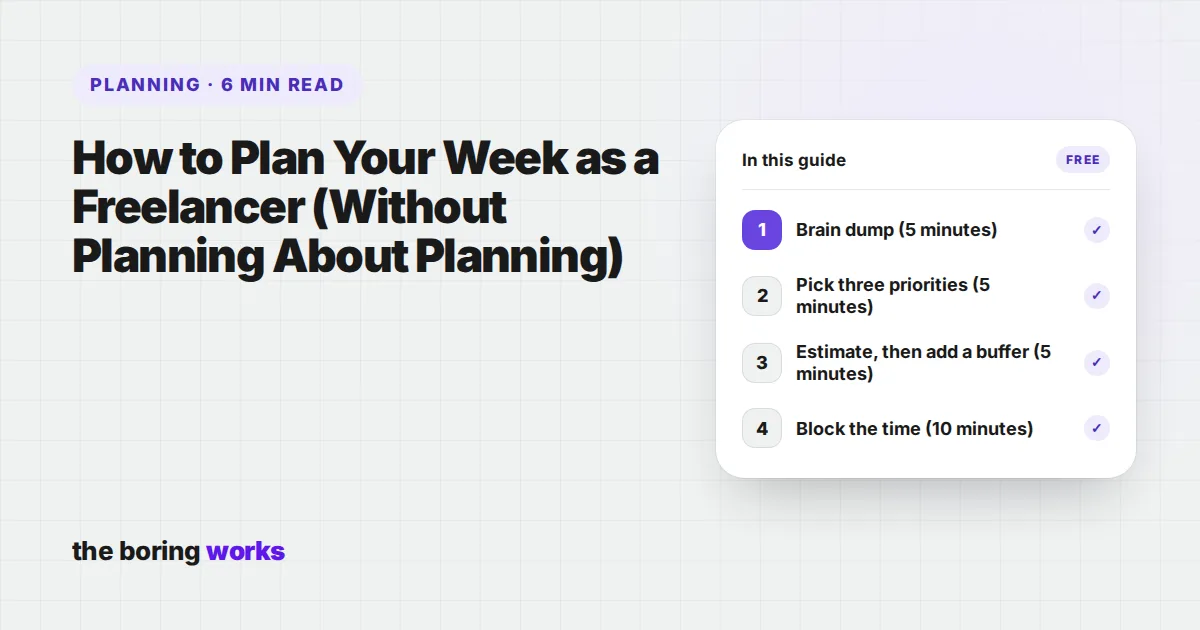
The short answerPlan your week in one 30-minute session. Write down everything on your plate, pick three priorities, block time for them before meetings and email, and add a midweek checkpoint. Finish each Friday with a short review, so next week starts from facts instead of guesses.
Monday, 9:04am. You open your laptop and see 47 unread emails, three half-finished projects, and a calendar that looks like someone dropped a box of crayons. You tell yourself you will just "get the small stuff out of the way first". It is now Thursday. The small stuff is still not out of the way.
Most freelancers do not have a time problem. They have a decisions problem. Nobody is telling you what matters this week, so the loudest message wins. A short weekly plan fixes that, because it makes the decisions once, on purpose, instead of forty times a day by accident.
Why plan the week instead of the day?
A day is too small. Client work arrives in chunks that run over several days, and a bad Tuesday can wreck a plan that only covered Tuesday. A week is big enough to see the shape of things: which deadlines are close, which project needs a long block of focus, and where you can fit the work that never has a deadline but quietly pays your bills, like finding new clients.
Planning guides for solo business owners, like this one from SelfEmployed.com, share the same basic shape: a short planning session at the start of the week, a small number of priorities, and time blocks on the calendar. None of it is clever. It is just done on purpose.
What do you need before you plan your week?
- Your calendar for the next 7 days, with the fixed things already in it
- Every active client project and its next deadline
- Your inbox, but only to scan it, not to answer it
- Last week’s notes: what slipped, what took longer than you thought
- A rough idea of the money you need to bring in this month
How do you plan your week in 30 minutes?
- 1Brain dump (5 minutes)Write down everything you could do this week. Client work, admin, invoices, marketing, that email you keep avoiding. Do not sort it yet. Getting it out of your head is the point.
- 2Pick three priorities (5 minutes)Which three things would make this a good week? Not ten. Three. Usually two are client deadlines and one is something for your own business.
- 3Estimate, then add a buffer (5 minutes)Guess how long each priority will take, then add some extra. Work almost always takes longer than the first guess, so leave room for it.
- 4Block the time (10 minutes)Put each priority on the calendar as a real appointment. Give your best hours to your hardest work and put meetings and email around it, not on top of it.
- 5Add a midweek checkpoint (5 minutes)Pick Wednesday or Thursday for a two-minute check. Is the plan still true? If something slipped, cut scope instead of cutting sleep.
What is time blocking, and does it work for freelancers?
Time blocking means giving each task a slot on your calendar instead of leaving it on a list. A list tells you what to do. A block tells you when. It works especially well for freelancers because nobody else is protecting your time, so you have to protect it yourself, in writing, on the calendar where you can see it.
| Reactive week | Planned week |
|---|---|
| Open email first, plan later (never) | Three priorities, picked on Monday |
| Everything is urgent, so nothing is finished | Hard work blocked before meetings and email |
| Client work eats the whole week, marketing waits | A weekly slot for finding new clients |
| Friday arrives and you cannot say what you did | A short Friday review, so next week is easier |

Should you block time for marketing and finding clients?
Yes, and treat it like a client deadline. Pipeline work is the first thing pushed out when client work gets busy, and many freelancers protect a weekly marketing block for exactly that reason. That is how a freelancer ends up with a full month and an empty next month. A weekly block, even an hour, keeps outreach and follow-ups moving. Some people put it midweek instead of Friday, because Friday is when it gets cancelled.
What does a planned freelance week look like?
Three priorities
1. Finish the draft for the Kim project (client deadline Thursday)
2. Send two proposals and follow up with last week’s leads
3. Update my portfolio with the last finished project
Monday
9:00 to 11:30 Kim project, deep work (phone away)
11:30 to 12:00 Email and messages, then stop
Wednesday
9:00 to 10:30 Proposals and follow-ups (the marketing block)
4:00 Midweek checkpoint: is the plan still true?
Friday
3:30 to 4:00 Weekly review, then close the laptop
Notice what is not in there: a packed schedule. The plan has gaps on purpose. A client will call, something will break, and a task will take twice as long as you thought. Gaps are what stop one surprise from turning the whole week upside down.
What should you ask in a Friday weekly review?
The review is where the system gets better. Without it, you repeat the same mistakes with a new calendar. Keep it short, about ten to fifteen minutes, and answer the same few questions every week.
- What did I finish, and what did not get done?
- Which task took much longer than I guessed, and why?
- Where did my time actually go, compared to the plan?
- Did I protect one block for finding new clients?
- What is the single most important thing for next Monday?
How many hours a day should a freelancer plan for?
Fewer than you think. Some freelancers cap their planned client work at around five or six focused hours a day and leave the rest for admin, email, and the unexpected. That number is a personal rule, not a law, so start with what you can honestly manage on an average day, then plan a little less. A plan you can actually keep beats an ambitious one you abandon by Wednesday.
If your weeks keep overflowing no matter how you plan, the plan may not be the problem. Read freelancer burnout next, because chronic overload and weak boundaries are often the real cause.
Questions people ask
Set aside 30 minutes at the start of the week. Write down everything on your plate, pick three priorities, estimate the time with a buffer, block it on your calendar, and add a midweek checkpoint.
Sunday evening or Monday morning both work. Pick one and keep it the same, so it becomes a habit. Some people plan on Friday afternoon so Monday starts with a ready plan.
Three is a good number. It is small enough to finish and big enough to matter. Everything else on the list is a bonus, not a failure.
Start simple. A calendar with blocks plus a short Friday review will show you where your time really goes. Add a timer only if you bill by the hour or the review leaves you guessing.
No. A calendar and a notes page are enough. The habit of planning matters far more than the tool. A printed or ready-made planner can help if you like having it all in one place.