Outreach
Cold Email Templates for Freelancers and Agencies (That Do Not Sound Like Spam)
By Aetisam · · 6 min read
The short answerA good cold email is short, about them, and asks for one small thing. Open with something specific to the person, say what you do in one line, make a single low-effort ask, and plan two or three follow-ups over about two weeks. Each follow-up should add something new, not just say "bumping this".
You have a skill, a portfolio, and a list of people who could really use your help. You open a blank email and the first line you write is "I hope this email finds you well". You delete it. You write "My name is..." and delete that too. Forty minutes later, you are reorganising your desktop.
Cold emailing feels awkward because most of what lands in our inboxes is bad. The good news is that a clear, short, human email stands out for exactly that reason. This guide gives you the structure and the templates, so you are never staring at a blank screen again.
What makes a cold email work?
Cold email guides for freelancers (see the sources at the end) point the same way: make it about the reader. Reference something specific, like a project, an article, or a gap you noticed, so it is clear a real person wrote it for them. Then keep the rest short and easy to answer.
| Gets deleted | Gets read |
|---|---|
| "I hope this finds you well" as the first line | A first line that could only be sent to them |
| A paragraph about you and your services | One sentence on what you do and why it matters to them |
| A generic subject line like "Quick question" | A subject line that is specific and short |
| A request for a 30-minute call | One small, easy ask |
What should a cold email include?
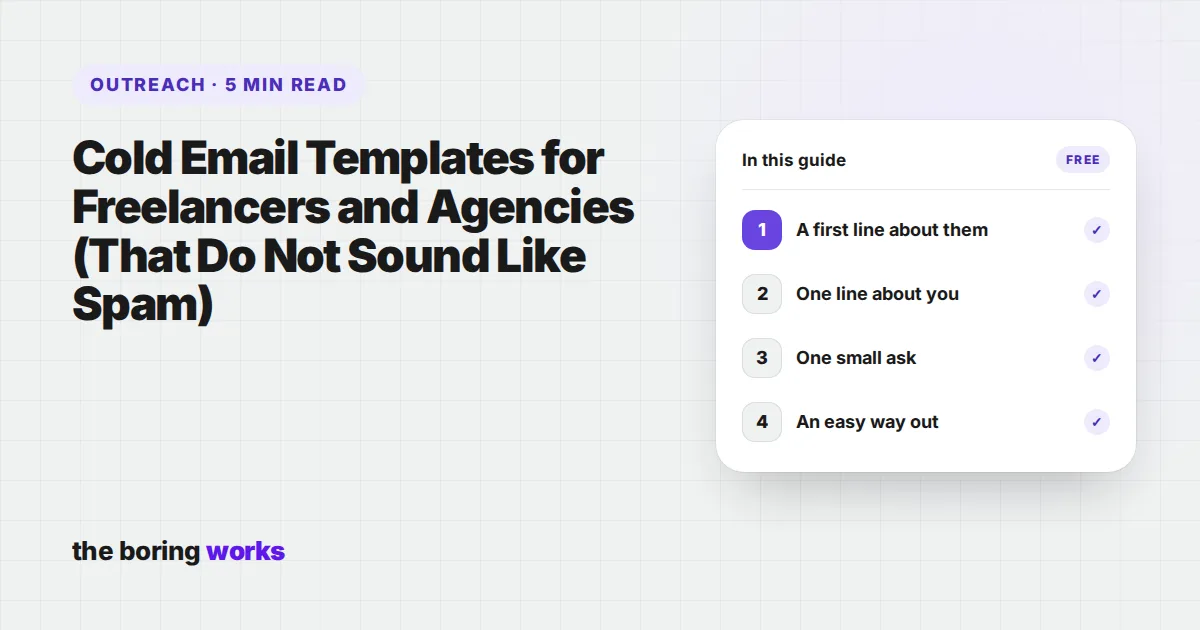
- 1A first line about themSomething specific: a post they wrote, a launch, a page that could be better. It proves you looked.
- 2One line about youWhat you do, who you do it for, in plain words. No life story.
- 3One small askA low-effort question or offer, such as "Would it help if I sent a quick idea?" Some guides advise against asking for a long call in the first email.
- 4An easy way outSay it is fine to say no. It lowers the pressure and makes replies more honest.
What is a good cold email template for freelancers?
Here is a first email and a three-step follow-up plan, based on a common structure: day 3, day 7, and day 14. Change the details so every message is genuinely about the person you are writing to.
Email 1 (day 0)
Subject: Idea for [their project or page]
Hi [Name], I read your post on [specific thing] and liked [one genuine detail]. I’m a [what you do] who helps [type of business] with [one clear benefit]. I noticed [a specific gap or idea]. Would it help if I sent over a short idea for it? No worries if not.
Follow-up 1 (day 3): add something new
Subject: Re: Idea for [their project or page]
Hi [Name], one more thought: [a short, useful tip or example related to their business]. Happy to share the full idea if it’s useful.
Follow-up 2 (day 7): show a small proof
Subject: A quick example
Hi [Name], here’s a recent example of what I mean: [link or one line about similar work]. If it’s relevant, I’d love to talk about [their project].
Follow-up 3 (day 14): the friendly close
Subject: Closing the loop
Hi [Name], I’ll stop here so I don’t clutter your inbox. If the timing is ever right, you know where to find me. Wishing you a great [month or season].
Which subject lines should you avoid?
Generic ones. Email vendors such as Warmy list lines like "Quick question" and "Partnership opportunity" as examples that blend in with everything else in an inbox. A better subject line is short, specific to the recipient, and honest about what is inside.
Specific to them
An idea for your pricing page
Thoughts on your [month] launch
Plain and honest
A small suggestion for [their business]
A question about your [specific thing]
Follow-ups
Re: An idea for your pricing page
Closing the loop

How many follow-ups should you send, and when?
- Step 1Day 0First email, about them, one small ask
- Step 2Day 3Follow-up that adds something new
- Step 3Day 7Follow-up with a small proof or example
- Step 4Day 14A friendly close, then stop
Each follow-up should give the reader something, not just remind them you exist. Our guide to following up with a client goes deeper on tone and timing.
Is cold emailing allowed?
Rules depend on where you and your recipients are. In the United States, commercial email has to follow the CAN-SPAM Act, which includes a clear way to opt out. In the UK and EU, rules on unsolicited business email are stricter and differ by country. This is general information, not legal advice, so check the rules for the places you email, and always honor an opt-out straight away.
- The first line could only be sent to this person
- It is under about 100 words
- There is one small ask, not three
- The subject line is specific and short
- There is an easy way to say no or opt out
- You have a follow-up plan and a date to stop
Who should you send cold emails to?
Fewer people, chosen better. A short list of businesses you genuinely understand beats a huge list you know nothing about. Look for people who clearly need what you do and who you can say something specific about, like a site with an outdated page, a product launch, or a post that shows a problem you solve.
- Start with 20 prospects, not 2,000, and personalise every first line.
- Keep a simple note for each: why them, what you noticed, and when you wrote.
- Aim for people who can say yes, not a general inbox.
- Skip anyone who has told you no, and honor opt-outs immediately.
What should you do when someone replies?
Answer quickly, answer the question they asked, and keep the next step small. Do not paste a long pitch the moment they show interest. A reply is a conversation starting, not a closing moment.
They say yes to your idea
Great, thanks for replying. Here’s the idea in brief: [two or three lines]. If it’s useful, the next step could be a 15-minute call. Does [day] or [day] work?
They say not now
Totally understand, thanks for letting me know. Would it be OK if I checked back in [month]?
They ask your price
It depends on the scope. For something like [what they described], it’s usually [range]. Happy to send an exact quote once I know a bit more.
Questions people ask
A first line about the recipient, one line about what you do, one small ask, and an easy way out. Keep it short and specific to them.
Short. Many guides suggest under about 100 words. If it needs scrolling, it is probably too long.
Guides vary, but a first email plus two or three follow-ups over about two weeks is a common starting point. Make each one add value, and stop at a clear no.
Something short, specific to the recipient, and honest, such as "An idea for your pricing page". Avoid generic lines like "Quick question" that look like everything else in the inbox.
It depends on where you and the recipient are. In the US, CAN-SPAM requires a clear way to opt out, while the UK and EU have stricter rules. This is not legal advice, so check the rules where you send.