
Boundaries
How to Say No to a Client Politely (With Scripts That Keep the Relationship)
By Aetisam · · 5 min read
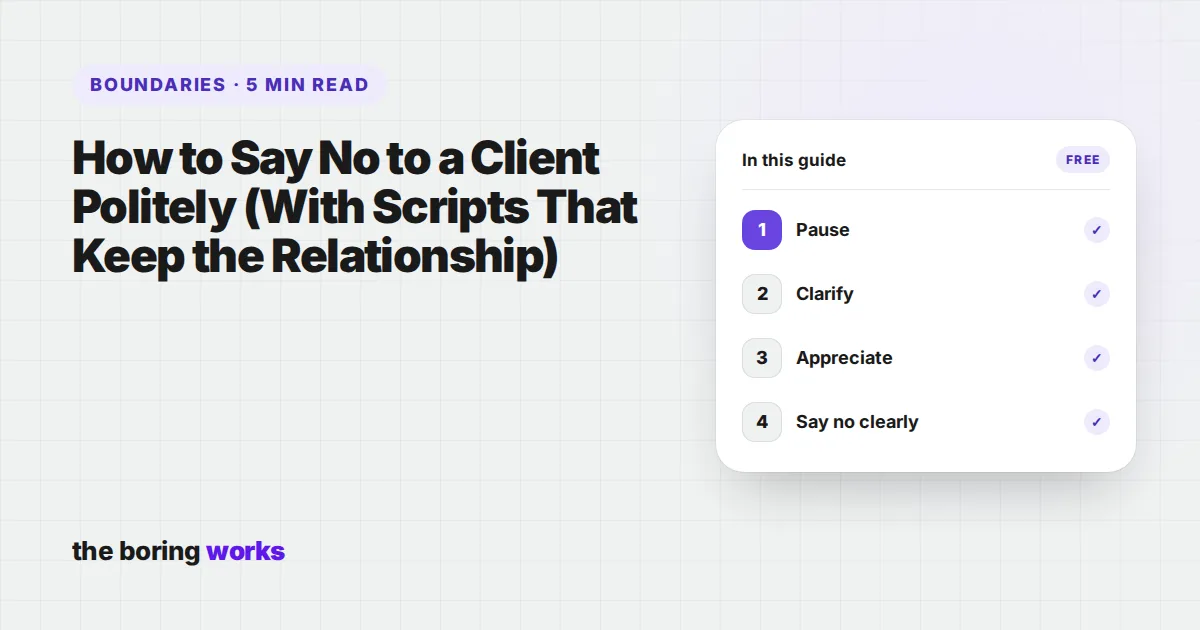
The short answerTo say no to a client politely, pause before you answer, make sure you understand the request, thank them, say no clearly in one short sentence, and offer an alternative if you have one. Keep it warm and brief, and reply soon so they can move on.
The email arrives at 4:47pm on a Friday. "Hi! Quick favor, could you turn this around by Monday? It should only take a few minutes." You know it will not take a few minutes. You know you already have plans. You type "Sure, no problem!" before your brain has a vote.
Most freelancers say yes far too quickly, because every no feels like it might cost a client. But a thoughtful no is part of the job. It protects your time, your quality, and your sanity. The trick is saying it in a way that makes the client trust you more, not less.
Why is it so hard to say no to clients?
A common reason is money worry. When income is not guaranteed, every request feels like it might be the last one. Add the fear of looking difficult, and a quick "yes" becomes a habit. The problem is that a yes you resent gets worse work and a worse mood, and it sets a pattern you then have to live inside.

What is the best way to say no to a client?
Freelancer guides from FreshBooks, Pepper Content and Indy describe much the same method. It comes down to five short steps.
- 1PauseDo not answer on the spot. Saying yes is often a reflex, so give yourself time to decide and plan a kind reply.
- 2ClarifyAsk a question or two so you understand the request. Sometimes it is smaller than it sounded, and sometimes it is bigger.
- 3AppreciateStart with thanks or empathy for what they are trying to do. It keeps the relationship intact.
- 4Say no clearlyOne short, direct sentence. A brief reason is fine, but you do not owe a long explanation.
- 5Offer an alternativeA later date, a smaller version, a paid add-on, or someone else who could help.
What can you say? Scripts for common situations
Extra work outside the agreement
Thanks for thinking of me, that’s a good idea. It’s outside what we agreed for this project, so I’d quote it separately. Want me to send a price?
A rush job
I’d love to help, but I can’t do this by Monday without dropping something I’ve promised to someone else. I can deliver by Thursday, or I can offer a rush rate if you’d like it sooner.
A budget that is too low
Thank you for the details. At that budget I can’t do this at the quality I’d want to deliver. If it helps, I can do a smaller version for [price], or point you to someone whose rates fit better.
A project that is not a good fit
Thanks for thinking of me. It’s not quite my area, so you’d get better results elsewhere. I’d suggest [name or resource], and I’m happy to introduce you.
A fully booked calendar
I’m fully booked until the 20th. I can start on the 21st if the timing works, or I can suggest someone who has space sooner.
A client who keeps pushing
I hear you, and I want this to go well. My answer on this one has to stay the same. Here’s what I can do instead: [option].
When is it right to say no?
- The request is outside the scope you agreed, and you have not been paid for it.
- The deadline would force you to drop work you already promised.
- The budget is far below what the work needs.
- The project is outside what you do well.
- The client has a history of ignoring boundaries or paying late.
- You are already running on empty. See freelancer burnout.
| Rushed yes | Calm no |
|---|---|
| "Sure, no problem!" in 30 seconds | A pause and one clarifying question |
| Resentment by Sunday | Thanks, then one clear sentence |
| Rushed work, a worse result | An alternative on the table |
| The next ask is bigger | A client who knows where you stand |
How do you stop needing to say no so often?
Most no’s are really missing agreements. When the scope, revisions, and timeline are written down at the start, you spend far less time declining things, because the answer is already in the document. Our scope of work template and guide to handling scope creep cover exactly that.
How do you say no to a client you want to keep?
Make the no about the request, never about the person. Say what you can do instead, and be generous about the next step. "Not this, but here is what I can do" keeps the door open and shows the client you are thinking about their goal, not just your calendar.
Good client, wrong moment
I really want to work on this with you. I can’t take it on properly before [date], and I’d rather do it well than rush it. Could we start then?
Good client, outside your skills
This one is outside what I do best, and I’d hate for you to get a second-rate result. I’d recommend [name], and I’m happy to share what I know about the project.
What if you need to end a client relationship?
Sometimes a client is the problem: late payments, constant scope changes, or messages that make your stomach drop. Ending it is allowed. Do it kindly and in writing, finish what is owed, and follow the contract. Our client offboarding checklist walks through how to close things out cleanly.
Questions people ask
Pause, clarify the request, thank them, say no in one clear sentence, and offer an alternative if you can. Keep it short and warm, and reply quickly so they can move on.
Not usually, if you do it kindly and with an alternative. Many clients respect a freelancer who knows their limits, because it suggests they will also be honest about deadlines and quality.
No. A short reason can help, such as "I’m fully booked", but you are not obliged to give a long explanation. Clear and kind is enough.
Say yes to the idea, point to what was agreed, and offer a price and a date for the extra work. That turns a refusal into a choice for the client.
If you know someone who is a good fit, yes. A referral keeps goodwill and shows you care about the outcome, even when you cannot do the work yourself.