
Money
How Much to Set Aside for Taxes as a Freelancer (A Simple System)
By Aetisam · · 5 min read
The short answerThere is no single percentage that fits every freelancer, because it depends on your income, country, and deductions. A practical system is to move a fixed share of every payment into a separate tax account the day you are paid, then adjust the share with an accountant. This is general information, not tax advice.
The scariest part of freelance tax is not the form. It is opening your bank account in the month the bill arrives and finding that you spent the money. When you are an employee, tax comes out before you see your pay. When you work for yourself, you see all of it and nobody reminds you to keep any.

What percentage of income should you set aside?
There is no honest one-size answer. It depends on how much you earn, where you live, what you can deduct, and whether you also have a job with tax already taken out. If you have no number yet, pick a fixed share as a placeholder (many freelancers start somewhere around a quarter to a third of each payment) and keep it separate until an accountant or the official tools give you a better figure. Over-saving is a lot less painful than under-saving.
What is the simplest system?
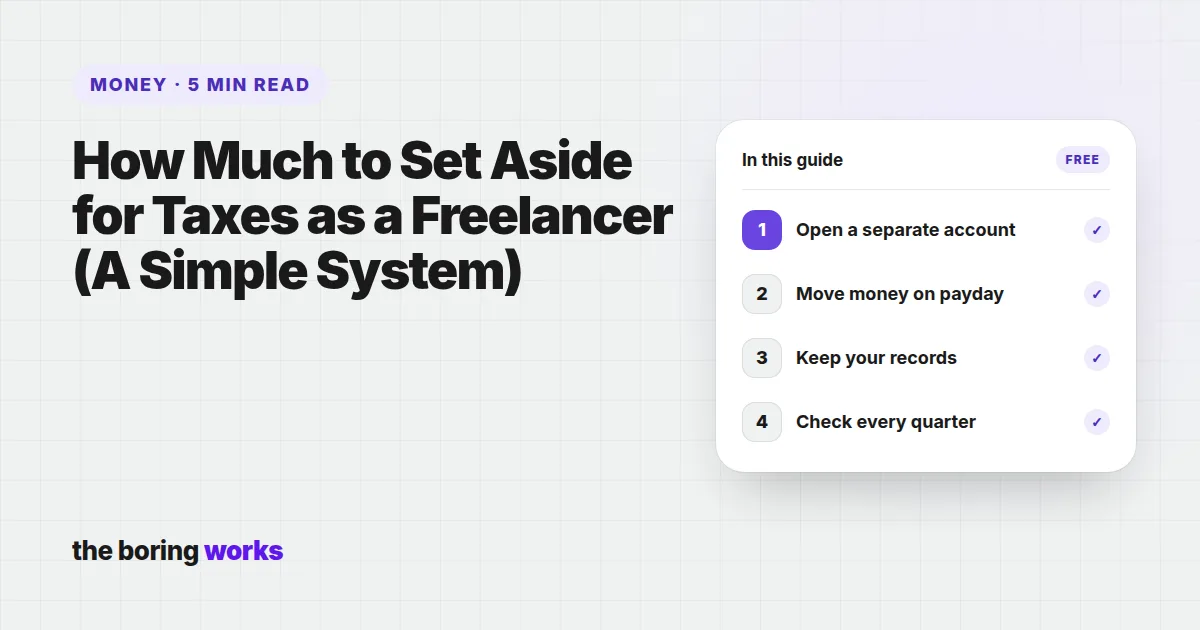
- 1Open a separate accountA savings account just for tax. Do not use it for anything else.
- 2Move money on paydayThe day a client pays, move your share across before you spend any of it.
- 3Keep your recordsSave invoices and receipts in one folder as you go.
- 4Check every quarterLook at income so far, the tax account balance, and any payments due.
- 5Talk to an accountantOnce or twice a year, adjust your share and check what you can deduct.
What do US freelancers need to know?
In the US, the IRS says people who expect to owe tax, such as self-employed people, generally pay it through estimated payments during the year instead of one lump sum. The standard schedule has four payments, usually in April, June, September, and January. Dates move when they land on a weekend or holiday, and rules can change, so check the IRS page for the current year before you pay.
What do UK freelancers need to know?
In the UK, GOV.UK explains that many Self Assessment taxpayers make "payments on account", advance payments toward next year's bill, usually due on 31 January and 31 July. The first one can arrive on the same day as your final bill for the previous year, which is why a separate tax account helps. Check GOV.UK for the details that apply to you.
- Step 1Every paydayMove your tax share into the tax account
- Step 2Every quarterReview income, balance, and any payments due
- Step 3Before a deadlineCheck the amount, then pay from the tax account
- Step 4Once a yearMeet an accountant, adjust the share, plan next year
What records should you keep?
The goal is that tax time is a check, not a search. Save things as they happen and you will not spend a weekend hunting through your email.
- Every invoice you send, with the date it was paid
- Receipts for business costs (software, equipment, travel)
- Bank and card statements for your business account
- A short note on any expense that is not obvious
- Records of tax payments you have made, with dates
- Anything from your accountant or tax authority
What mistakes cause tax stress?
- Spending all the money in the account because it looks like income
- Not knowing when the first payment is due
- Mixing personal and business spending, which makes records messy
- Waiting until the deadline to find out what you owe
- Never asking an accountant, even once
What if a client pays late?
Late payments make tax saving harder, because the money you planned to move has not arrived. Keep chasing, and keep your tax share linked to money actually received. Our unpaid invoice email templates cover each stage. And if you are always short, it may be worth looking at your pricing, which our guide to raising your freelance rates covers.
| Hope | A system |
|---|---|
| All income goes into one account | A fixed share moves on every payday |
| You guess the bill at the end of the year | A separate tax account builds up through the year |
| Receipts live in your email | Receipts go into one folder as you go |
| A payment deadline feels like a surprise | Deadlines are on the calendar with the money ready |
Make money admin a routine
Tax is one part of a bigger money system: pricing, invoicing, chasing payments, and setting aside what you owe. Once those live in checklists, they stop feeling like emergencies. The One-Person Business Systems Playbook covers tasks, clients, marketing, and money in one place.
Questions people ask
In the US, many self-employed people make quarterly estimated payments. In the UK, payments on account are usually due twice a year. Check the official guidance for your country and situation.
It is not required, but it is one of the easiest ways to avoid spending money you owe. Keeping it separate makes the balance visible and stops it from blending into daily spending.
A fixed share is a useful placeholder, but your real number depends on income, deductions, and where you live. Review it with an accountant at least once a year.
Invoices, receipts, bank statements, and notes on business expenses. Keep them in one folder as you go, so tax time is a check, not a search.