
Pricing
How to Raise Your Freelance Rates Without Losing Clients
By Aetisam · · 5 min read
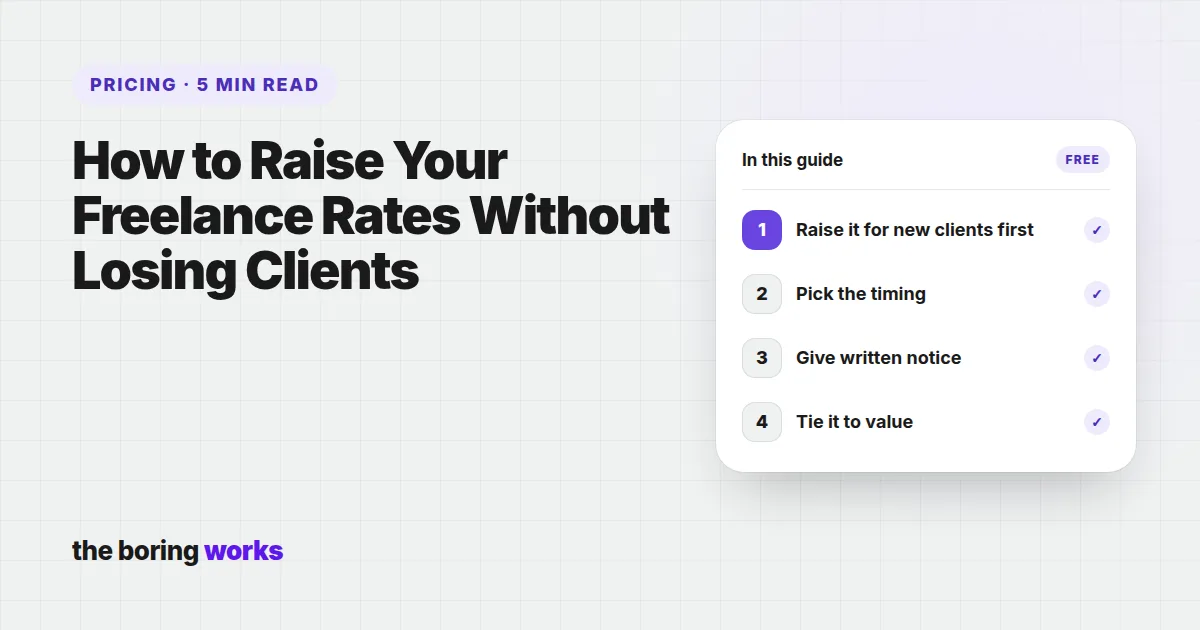
The short answerRaise your freelance rates by giving clients written notice (guides often suggest 30 to 60 days), tying the new rate to the work you now deliver, and keeping the change modest. Apply it to new clients right away and to existing clients at their next project or renewal.
Most freelancers set their first rate by guessing, then keep it for years because raising it feels rude. Meanwhile your costs go up, you get better at the work, and your old rate quietly turns into a discount. Raising your rates is not greedy. It is maintenance, like updating your software.
How do you know it is time to raise your rates?
There is no perfect moment, but some signs are hard to ignore. If three or more of these sound familiar, your rate is probably behind.
- Almost every proposal you send gets a yes with no questions
- You are booked solid but still worried about money
- Your rate has not changed in over a year
- You do the same work faster now than when you set the price
- Your costs have gone up (tools, tax, insurance, your time)
- You resent certain clients because of what they pay
How much should you raise your rates?
Keep it modest for existing clients. One agency tool vendor calls a 10 to 20 percent yearly increase normal, and another guide notes that clients who value you will often accept a small bump. Treat those as rules of thumb, not promises. For new clients, you can jump straight to the rate you actually want, because they have nothing to compare it to.
Before you pick a number, work out what you need. Add your costs, your tax, and the time you spend on work you cannot bill (admin, sales, email). Divide by the hours you can realistically bill, not the hours you are awake. That is your floor.
What is the safest way to roll out an increase?
- 1Raise it for new clients firstQuote the new rate today. It costs you nothing and tests the market.
- 2Pick the timingStart of a new project, start of a quarter, or a contract renewal all work. Avoid the middle of a stressful delivery.
- 3Give written noticeGuides often suggest 30 to 60 days. Put the new rate and the start date in writing.
- 4Tie it to valueName the work you now handle, the results you have delivered, or the responsibility you have taken on.
- 5Make it easy to say yesOffer a clear next step, and consider letting a long-term client book work at the old rate before the change.
What should the email say?
Short, kind, and clear. You are not asking permission and you are not writing an essay. State the new rate, the date it starts, and the reason in one line.
Subject: A quick update on my rates from [Month]
Hi [Name],
Thank you for working with me this past year. I have enjoyed [one specific project or result].
To keep delivering at this level, my rates will change from [old rate] to [new rate], starting [date]. Anything booked before then stays at the current rate.
If you would like to book your next project or lock in more work before [date], reply here and I will set it up.
Happy to talk it through if that is easier.
Thanks again,
[Your name]
How do you set the rate for a new client?
New clients are the easy part of pricing, because they only see the number you give them. There are three common ways to charge, and each fits a different kind of work.
- Hourly: simple to start, but it rewards slow work and makes you explain every hour
- Per project: a fixed price for a clear scope, which rewards being fast and good
- Retainer: a monthly fee for an agreed amount of ongoing work, which makes your income easier to plan
Whatever you pick, write the scope down first. A higher price with a tight scope is easier to defend than a lower price with a vague one. If you need a starting point, our scope of work template covers deliverables, exclusions, and timeline.
What mistakes make a rate increase harder?
- Announcing it in the middle of a stressful delivery
- Apologizing, which tells the client the price is negotiable
- Raising the rate and quietly doing more work to justify it
- Waiting so long that the jump feels huge
- Sending it with no date, so nobody knows when it starts
What if a client pushes back?
First, stay calm. A question is not a no. Ask what worries them, and decide in advance how much room you have. You can adjust the scope instead of the price: fewer deliverables, a longer timeline, or a smaller package at the old rate. What you should not do is quietly accept the old rate while doing the new amount of work.
| Folding | Holding calmly |
|---|---|
| Apologize and take the increase back | Thank them and explain what the rate covers |
| Offer a discount before they ask for one | Offer a smaller scope at a price that works for both |
| Keep the old scope at the old price forever | Agree an end date for any temporary arrangement |
What if you lose a client?
Sometimes it happens. A client who can only work with you at the old price was probably the one taking the most time for the least money. Losing one is uncomfortable, and it also frees up hours for a client who pays what the work is worth. This is easier when you are not relying on one client for most of your income, so keep a few leads warm.
Write the pricing down
The easiest increase is the one built into your process. If your proposals, packages, and scope of work are already written, you only change the number. The Solo Agency Starter Playbook has pricing and proposal guidance and workflows you can reuse for every client.
Questions people ask
Review your rates at least once a year. Many freelancers raise them every 12 months or whenever their skills, costs, or demand clearly change.
Guides commonly suggest 30 to 60 days of written notice. Check any contract you have signed, because it may set its own notice period.
You do not have to. Some freelancers raise rates for new clients first and move existing clients over one at a time, which makes the change easier to manage.
Some might. A modest, well-explained increase with notice is less likely to cause trouble than a big surprise. Keep a few leads warm so one client leaving does not put you under pressure.